
Hey everyone,
I've edited previous posts(and published some new ones) with pictures from the deployment and some projects that the children did.
I'm sure this will add some perspective. So, do indulge yourself,
Faaez
Sunday, August 9, 2009

Sustainability
Like all other teams, we did not want our project to fizzle away after we leave and so from the start, sustainability was an important consideration. Here are a few aspects of just that
1. Local Partnerships: Since Sahn Malen's affairs are overseen by a local chief, we met with him, introduced him to the project and elicited his help in things like security of the XOs(his office will have a detailed list of the children who have the XOs and their serial numbers in case of theft etc.).
The chief also held a village-wide meeting where we introduced ourselves and the project to the community and talked about aspects that we felt were important(child ownership of the laptops, security of the XOs and the children, importance of the local community's support to the project and the fact that this was the first village in Sierra Leone to have a deployment like this and hence its importance as a pilot project).
We also had a meeting with the parents of the children who received the XOs. This we conveniently did on the day when the parents were in town for collecting their childrens' report cards.
Furthermore, it was important to get the local school staff on board. We had frequent meetings with both the schools' principals and the class 5 teachers to update them on the project.
2. Hedging the bets: I've already described the structure of the program in a previous post, whereby we will have local adult leads who will be responsible for different aspects of the program. But to make sure that the program doesn't fall apart in case one member moves away or is unable to continue with the project for whatever reason, we worked with and trained three local volunteers as well who would take over in case of a contingency.
3. Finances: The only running costs we will incur after we have left will be the stipends for the local adult leads, scholarships for the peer tutors, internet connectivity charges and any spare parts that we send to Sahn Malen. We planned our current finances to provide for one year(until June 2010). For beyond this, we will fundraise once we get back to the US. The funds will be dispensed to the relevant individuals by our local partner, Mr. Paul Sengeh, Project Evaluation Officer at UNICEF, Sierra Leone.
4. Accountability: The peer tutors will keep receiving their scholarship and the adult leads their stipend only if they show continuous commitment to the project and deliver what is expected of them. To make this clear, the adult leads signed a Memorandum of Understanding with us, which explicitly listed their responsibilties and ours for the coming year.
5. Communication: To ensure accountability however, we need and plan to remain in constant touch with the adult leads, the peer tutors and our local partners in the village(Chief Kebbie and Elder Sengeh) to ensure that everything is running smoothly. In addition to the monthly telephonic conversations, we are also in touch with the adult leads over email.
1. Local Partnerships: Since Sahn Malen's affairs are overseen by a local chief, we met with him, introduced him to the project and elicited his help in things like security of the XOs(his office will have a detailed list of the children who have the XOs and their serial numbers in case of theft etc.).
The chief also held a village-wide meeting where we introduced ourselves and the project to the community and talked about aspects that we felt were important(child ownership of the laptops, security of the XOs and the children, importance of the local community's support to the project and the fact that this was the first village in Sierra Leone to have a deployment like this and hence its importance as a pilot project).

We also had a meeting with the parents of the children who received the XOs. This we conveniently did on the day when the parents were in town for collecting their childrens' report cards.
Furthermore, it was important to get the local school staff on board. We had frequent meetings with both the schools' principals and the class 5 teachers to update them on the project.
2. Hedging the bets: I've already described the structure of the program in a previous post, whereby we will have local adult leads who will be responsible for different aspects of the program. But to make sure that the program doesn't fall apart in case one member moves away or is unable to continue with the project for whatever reason, we worked with and trained three local volunteers as well who would take over in case of a contingency.
3. Finances: The only running costs we will incur after we have left will be the stipends for the local adult leads, scholarships for the peer tutors, internet connectivity charges and any spare parts that we send to Sahn Malen. We planned our current finances to provide for one year(until June 2010). For beyond this, we will fundraise once we get back to the US. The funds will be dispensed to the relevant individuals by our local partner, Mr. Paul Sengeh, Project Evaluation Officer at UNICEF, Sierra Leone.
4. Accountability: The peer tutors will keep receiving their scholarship and the adult leads their stipend only if they show continuous commitment to the project and deliver what is expected of them. To make this clear, the adult leads signed a Memorandum of Understanding with us, which explicitly listed their responsibilties and ours for the coming year.
5. Communication: To ensure accountability however, we need and plan to remain in constant touch with the adult leads, the peer tutors and our local partners in the village(Chief Kebbie and Elder Sengeh) to ensure that everything is running smoothly. In addition to the monthly telephonic conversations, we are also in touch with the adult leads over email.
Some suggestions for OLPC/ future deployments
There were a couple of observations we thought might be useful for future OLPC deployments:
1. The solar panels we received from GP Solar had very flimsy construction on the back. A number of them had the back panels(that cover the wire ganglion coming out of the panel) came off on the very first use. This was probably a problem specific to this consignment because none of the six panels we had from the December deployment had such issues. They work pretty well regardless and I doubt that it will have much of an effect on their performance, but nevertheless this is something that could maybe be taken up with the manufacturer.

2. The color palette in Paint is pretty counter-intuitive with its external dial for color and internal triangle for gradation. The kids(and teachers) had a hard time getting hang of it. Maybe a simpler palette like the one in Adobe applications in the next version of Sugar?
3. The scroll bar in Browse etc. should be more visible.
4. Menus should be navigable by keyboard arrow keys, given that the mouse pad goes awry so frequently/ a better mouse pad could be used.
5. Sometimes USB memory sticks would stop mounting inexplicably. The solution was to use a PC/Mac to open the USB and delete the five hidden folders in the drive that start with a dot(like .olpc.store and .TemporaryItems). This probably reset folder parsing information for Sugar, since it doesn't work with folders.
6. Double-click speed for apps that do use them(e.g. Firefox) is too fast. Is there a way to reduce that?
7. This might work differently for different deployments, but we found that the traditional classroom-like approach where we stood up front and tried to "teach" children how to do stuff, didn't work. I mentioned this in an earlier post, I think, but working with a few children and teaching them how to do things one-on-one would ensure that the knowledge spread like a virus. Or like NAND-blasting upgrades. Hm, maybe that last analogy was a bit overboard. In any case, you get my point.
8. Sierra Leoneans love their buzzwords. So did Rwandans. And it's important to get past them. In Rwanda, there was the ICT(Information and Communication Technologies) and in Sierra Leone, it is the haloed "Computer Literacy". I feel like it would be dangerous to let the OLPC delployment and the XOs be bundled under and restricted by those headlines. So for us, it was important to continuously emphasize that OLPC is more than just about computer literacyand that it is first and foremost an educational project.
1. The solar panels we received from GP Solar had very flimsy construction on the back. A number of them had the back panels(that cover the wire ganglion coming out of the panel) came off on the very first use. This was probably a problem specific to this consignment because none of the six panels we had from the December deployment had such issues. They work pretty well regardless and I doubt that it will have much of an effect on their performance, but nevertheless this is something that could maybe be taken up with the manufacturer.

2. The color palette in Paint is pretty counter-intuitive with its external dial for color and internal triangle for gradation. The kids(and teachers) had a hard time getting hang of it. Maybe a simpler palette like the one in Adobe applications in the next version of Sugar?
3. The scroll bar in Browse etc. should be more visible.
4. Menus should be navigable by keyboard arrow keys, given that the mouse pad goes awry so frequently/ a better mouse pad could be used.
5. Sometimes USB memory sticks would stop mounting inexplicably. The solution was to use a PC/Mac to open the USB and delete the five hidden folders in the drive that start with a dot(like .olpc.store and .TemporaryItems). This probably reset folder parsing information for Sugar, since it doesn't work with folders.
6. Double-click speed for apps that do use them(e.g. Firefox) is too fast. Is there a way to reduce that?
7. This might work differently for different deployments, but we found that the traditional classroom-like approach where we stood up front and tried to "teach" children how to do stuff, didn't work. I mentioned this in an earlier post, I think, but working with a few children and teaching them how to do things one-on-one would ensure that the knowledge spread like a virus. Or like NAND-blasting upgrades. Hm, maybe that last analogy was a bit overboard. In any case, you get my point.
8. Sierra Leoneans love their buzzwords. So did Rwandans. And it's important to get past them. In Rwanda, there was the ICT(Information and Communication Technologies) and in Sierra Leone, it is the haloed "Computer Literacy". I feel like it would be dangerous to let the OLPC delployment and the XOs be bundled under and restricted by those headlines. So for us, it was important to continuously emphasize that OLPC is more than just about computer literacyand that it is first and foremost an educational project.
Sample Student Projects
Hey all,
So we have wrapped up in Sahn Malen and I am home right now. It's been a great two months and I'm looking forward to going back some day already. Thanks to all of you who have been reading our blogs.
The project for us, however, is hardly over. We've merely moved into phase II of the project which will include continuous support, technical and otherwise, to the team in Sahn Malen, fundraising and scouting out opportunities for further expansion of the project.
As I said, the children were already making great progress with their XOs and I have some sample projects that I thought I would share. We will be using this blogspace to keep uploading projects from students in Sahn throughout the year.
1. 9 years old Eva and 12 years old Fanta recorded a local song in Mende using the Record activity. Eva and Fanta are in class 3 and 5 respectively and Eva is the girl in the foreground:
2. Francis Jibrilla, one of our younger peer tutors, uses paint for this masterpiece:


6. Now for my favorite project from the summer: One of the peer tutor groups decided to(admissibly with some egging from us) do a project related to malaria, since it was such a buzz in the village over the summer(because of our parallel malaria nets project; for more, check out the updates in the top-right corner of this page). In the beginning, the peer tutor, Mohammad Jalloh, explained to his children how malaria was transferred and where and how mosquitoes breed and then the children went out in small teams to photograph potentially good mosquito-breeding sites. They used Record to do this. Afterward, they got together and explained to their peers why they thought it was a good site and what could be done to repair it. Here are some photos that they took with their XOs:





8. Thomas Gbonnie, one of the peer tutors is teaching Alpha Sengeh how to use Record to conduct an interview:
That's it for now. But do stay tuned, we will be updating the blog throughout the year with projects that the adult leads send us over email.
Faaez
So we have wrapped up in Sahn Malen and I am home right now. It's been a great two months and I'm looking forward to going back some day already. Thanks to all of you who have been reading our blogs.
The project for us, however, is hardly over. We've merely moved into phase II of the project which will include continuous support, technical and otherwise, to the team in Sahn Malen, fundraising and scouting out opportunities for further expansion of the project.
As I said, the children were already making great progress with their XOs and I have some sample projects that I thought I would share. We will be using this blogspace to keep uploading projects from students in Sahn throughout the year.
1. 9 years old Eva and 12 years old Fanta recorded a local song in Mende using the Record activity. Eva and Fanta are in class 3 and 5 respectively and Eva is the girl in the foreground:
2. Francis Jibrilla, one of our younger peer tutors, uses paint for this masterpiece:

3. Abie Mustafa, house:

4. Mohammad Jalloh, another one of our peer tutors from JSS III, makes Jacob look prettier than he actually is(combination of Record and Paint):

5. Fatmata George, another one of our budding singers from class 3:
6. Now for my favorite project from the summer: One of the peer tutor groups decided to(admissibly with some egging from us) do a project related to malaria, since it was such a buzz in the village over the summer(because of our parallel malaria nets project; for more, check out the updates in the top-right corner of this page). In the beginning, the peer tutor, Mohammad Jalloh, explained to his children how malaria was transferred and where and how mosquitoes breed and then the children went out in small teams to photograph potentially good mosquito-breeding sites. They used Record to do this. Afterward, they got together and explained to their peers why they thought it was a good site and what could be done to repair it. Here are some photos that they took with their XOs:


6. Sallamatu Kandeh, House (Paint):

7. Sallamatu Kandeh is the youngest(and one of the brigthest) peer tutor from JSS II. She used the Memory program on her XO to make an activity that would help her "tutees" to get to know each other better. She took a picture of each one of them and paired them with their names to create her own Memory activity. Here are some pictures:


8. Thomas Gbonnie, one of the peer tutors is teaching Alpha Sengeh how to use Record to conduct an interview:
That's it for now. But do stay tuned, we will be updating the blog throughout the year with projects that the adult leads send us over email.
Faaez
Friday, July 31, 2009
Going global: Internet in Sahn Malen
Date: 5:00 PM, July 29, 2009
Venue: RC School, Sahn Malen
It’s official: Sahn Malen is now online.
 Let me give you some context first: this is a small village in southern Sierra Leone (about 1500 people). No electricity, no running water. We have our daily group meetings by candlelight and every morning go to the nearest communal hand-pump to get water for flushing down the toilet, or taking a shower. It is connected to the big towns only by bumpy dirt tracks. And yet, here I am, sitting in a classroom full of children and teachers surfing the internet on their XOs.
It’s amazing to watch this happen.
I’ll be the first one to admit that doing so wasn’t easy but now that it’s done, I’m sure replicating it will be much easier. The first question was what connectivity option should we choose. From an ‘online-offline’ setup like KioskNet to something as sophisticated as a long-distance wi-fi link between Sahn Malen and the nearest online town- we gave some thought to quite few options. But as is usually the case, the best option turned out to be the simpler one as well: Sahn Malen gets some spotty cellular coverage. So I thought that with proper placement and an antenna with the right gain, we might be able to get a GPRS internet connection up and running. We came to Bo (the second-largest city in Sierra Leone and a 4-7 hour poda-poda drive away from Sahn Malen) and checked out the Zain office (a cellular company with the most pervasive network here). We found out the location of their towers in Sierra Leone and an employee there was kind enough to lend us his own personal modem to test the network in Sahn Malen, before we made the pricey purchase. We just needed an antenna to start the test.
There are quite a few tutorials available online which walk you through making your own cell phone antennas but none of them looked easy AND dependable at the same time. Especially not with the tools we had here. Luckily, while walking through the market in downtown Freetown, I came across cheap TV antennas that were rated up to 866 Mhz for UHF (Ultra High Frequency). Cellular networks here work on 900 Mhz and I thought the $10 investment would be worth the try. So I bought the antenna, a spare male-female pins pair for extra coaxial cable and split the modem open to get to the board, which would take an external antenna. A close look at the port showed that the port was about the same size as the port for wifi antennas in an XO. So I took a dysfunctional XO, snipped some wire off of it and hooked the modem up to the antenna with one of the spare coax pins that we had bought.


The only thing left to do now was to make sure that the antenna worked for the right frequency (i.e. 900 Mhz). A Do-It-Yourself Pringles “cantenna” tutorial gave some insight into the physics of this and I hoped that if I cut UHF receptors on the antenna down to size of a quarter wavelength of the cellular signals, we would get the right gain. The math for calculating that length looks like this:
Speed of radio waves in air = 3.0 * 10^8 m/s
Frequency = 900 Mhz = 9.0 * 10^8 Hz
Speed = Wavelength * Frequency
Wavelength = Speed/Frequency = 0.33 m
Quarter wavelength = 0.33/4 = 0.085 m = 8.5 cm
So I cut the UHF receptors down to 8.5 cm, disconnected the VHF receptors and set the antenna up in a place where we usually get the best signals. And voila, our laptop connected to the internet in a room where it doesn’t without the antenna.

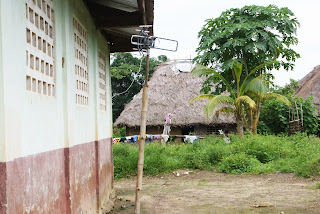
I wasn’t sure if the physics of it was accurate (in fact I still am not) but in a true manner of learning constructivist style, we just had to give it a shot. And it seems to work just fine. If you think this can be done better though, we’d love to hear from you.
All that was left to do was to install the modem and get it to run automatically on the school server (which has an OLPC-customized version of Fedora server installed). With little experience with linux, I had to tinker around with a lot of things (with some great help from Reuben and the people on the server-devel list at OLPC)- all of which don’t merit a mention here. As it turns out, if all the going around in circles is cut down, the procedure for installing a GPRS modem on the XS can be reduced to a few, relatively straightforward steps:
1. Plug the modem in and run: cat /proc/bus/usb/devices
2. Find the section that lists the name of your modem (in our case HUAWEI Mobile) and take down the Vendor and ProdID. Then run modprobe usbserial vendor= xxxx product=xxxx (replace the xs with the appropriate values for your model). Then run wvdialconf to create a default dial script for your modem.
3. Edit the wvdial.conf file by running nano /etc/wvdial.conf I am listing the contents of the one we used for reference:
[Dialer Defaults]
Modem = /dev/ttyUSB0
Init1 = ATZ
Init2 = ATQ0 V1 E1 S0=0 &C1 &D2 +FCLASS=0
Init3 = AT+CGDCONT=1,"IP","internet.sl.zain.com"
Stupid Mode = 1
Modem Type = USB Modem
Phone = *99#
New PPPD = yes
ISDN = 0
Username = blank
Password = blank
Baud = 460800
The important values which you will need to change depending on your case are:
5. Test the modem by running wvdial ; If it outputs primary and secondary DNS addresses, it means you’re connected to the internet. Test the connection on an XO/laptop connected to the server(in our case, it usually takes half a minute/minute after the modem has connected before the server starts accessing internet properly)
6. If the internet works on the XO, all that is left to do is create a udev rule that would automatically dial the modem when it’s plugged in, instead of someone having to run the wvdial command every time. Before you create the rule, you need some information about your modem. To find this, run udevinfo -a -p $(udevinfo -q path -n /dev/ttyUSB0) ; remember: /dev/ttyUSB0 is the path for the modem in our case; you should confirm what that path is from the cat /proc/bus/usb/devices command described in step 1. Now that you have these attributes, create a file in the udev rules folder by running nano /etc/udev/rules.d/10-usbmodem.rules , where 10-usbmodem.rules is the name of the file; you can change it as you wish. In the nano editor, enter something like this, changing the entries according to the values you found earlier from the udevinfo command:
the listed attributes.
And that’s it. You’re all set to see amazing things happen.
Clem’s sister does Teach for America and he is going to try and hook some peer tutors up with her students. We have already set email addresses up for all the adult leads and some peer tutors. In fact, as I finish this post off, I am seeing emails from all the adult leads and some peer tutors sitting in my inbox. Should go read them now.
I’m really looking forward to seeing how this unfolds over the next year.
Signing out,
Faaez
P.S: Many thanks to Reuben, the OLPC server-development team and Google for making this possible.


Venue: RC School, Sahn Malen
It’s official: Sahn Malen is now online.
 Let me give you some context first: this is a small village in southern Sierra Leone (about 1500 people). No electricity, no running water. We have our daily group meetings by candlelight and every morning go to the nearest communal hand-pump to get water for flushing down the toilet, or taking a shower. It is connected to the big towns only by bumpy dirt tracks. And yet, here I am, sitting in a classroom full of children and teachers surfing the internet on their XOs.
It’s amazing to watch this happen.
I’ll be the first one to admit that doing so wasn’t easy but now that it’s done, I’m sure replicating it will be much easier. The first question was what connectivity option should we choose. From an ‘online-offline’ setup like KioskNet to something as sophisticated as a long-distance wi-fi link between Sahn Malen and the nearest online town- we gave some thought to quite few options. But as is usually the case, the best option turned out to be the simpler one as well: Sahn Malen gets some spotty cellular coverage. So I thought that with proper placement and an antenna with the right gain, we might be able to get a GPRS internet connection up and running. We came to Bo (the second-largest city in Sierra Leone and a 4-7 hour poda-poda drive away from Sahn Malen) and checked out the Zain office (a cellular company with the most pervasive network here).
 We found out the location of their towers in Sierra Leone and an employee there was kind enough to lend us his own personal modem to test the network in Sahn Malen, before we made the pricey purchase. We just needed an antenna to start the test.
There are quite a few tutorials available online which walk you through making your own cell phone antennas but none of them looked easy AND dependable at the same time. Especially not with the tools we had here. Luckily, while walking through the market in downtown Freetown, I came across cheap TV antennas that were rated up to 866 Mhz for UHF (Ultra High Frequency). Cellular networks here work on 900 Mhz and I thought the $10 investment would be worth the try. So I bought the antenna, a spare male-female pins pair for extra coaxial cable and split the modem open to get to the board, which would take an external antenna. A close look at the port showed that the port was about the same size as the port for wifi antennas in an XO. So I took a dysfunctional XO, snipped some wire off of it and hooked the modem up to the antenna with one of the spare coax pins that we had bought.


The only thing left to do now was to make sure that the antenna worked for the right frequency (i.e. 900 Mhz). A Do-It-Yourself Pringles “cantenna” tutorial gave some insight into the physics of this and I hoped that if I cut UHF receptors on the antenna down to size of a quarter wavelength of the cellular signals, we would get the right gain. The math for calculating that length looks like this:
Speed of radio waves in air = 3.0 * 10^8 m/s
Frequency = 900 Mhz = 9.0 * 10^8 Hz
Speed = Wavelength * Frequency
Wavelength = Speed/Frequency = 0.33 m
Quarter wavelength = 0.33/4 = 0.085 m = 8.5 cm
So I cut the UHF receptors down to 8.5 cm, disconnected the VHF receptors and set the antenna up in a place where we usually get the best signals. And voila, our laptop connected to the internet in a room where it doesn’t without the antenna.


I wasn’t sure if the physics of it was accurate (in fact I still am not) but in a true manner of learning constructivist style, we just had to give it a shot. And it seems to work just fine. If you think this can be done better though, we’d love to hear from you.
All that was left to do was to install the modem and get it to run automatically on the school server (which has an OLPC-customized version of Fedora server installed). With little experience with linux, I had to tinker around with a lot of things (with some great help from Reuben and the people on the server-devel list at OLPC)- all of which don’t merit a mention here. As it turns out, if all the going around in circles is cut down, the procedure for installing a GPRS modem on the XS can be reduced to a few, relatively straightforward steps:
1. Plug the modem in and run: cat /proc/bus/usb/devices
2. Find the section that lists the name of your modem (in our case HUAWEI Mobile) and take down the Vendor and ProdID. Then run modprobe usbserial vendor= xxxx product=xxxx (replace the xs with the appropriate values for your model). Then run wvdialconf to create a default dial script for your modem.
3. Edit the wvdial.conf file by running nano /etc/wvdial.conf I am listing the contents of the one we used for reference:
[Dialer Defaults]
Modem = /dev/ttyUSB0
Init1 = ATZ
Init2 = ATQ0 V1 E1 S0=0 &C1 &D2 +FCLASS=0
Init3 = AT+CGDCONT=1,"IP","internet.sl.zain.com"
Stupid Mode = 1
Modem Type = USB Modem
Phone = *99#
New PPPD = yes
ISDN = 0
Username = blank
Password = blank
Baud = 460800
The important values which you will need to change depending on your case are:
a. Modem = (Enter the appropriate path for your modem; can be found by running cat /proc/bus/usb/devices ; in our case, it was /dev/ttyUSB0)4. Change the firewall rules to take the modem as the default internet connection by running nano /etc/sysconfig/olpc-scripts/iptables.principal and nano /etc/sysconfig/olpc-scripts/iptables.principal.cache The former stores the firewall rules for when Squid is turned off and latter for when it is on. In both these files look for the entry “-A POSTROUTING –o eth0 –j MASQUERADE” and change “eth0”(could be eth1 if you switched the nic roles earlier) to “ppp0”. This should tell the firewall to redirect requests for internet to the USB modem.
b. Init3 = AT+CGDCONT = 1, “IP”, “internet.sl.zain.com” (change the last entry to the appropriate APN for your cellular network)
5. Test the modem by running wvdial ; If it outputs primary and secondary DNS addresses, it means you’re connected to the internet. Test the connection on an XO/laptop connected to the server(in our case, it usually takes half a minute/minute after the modem has connected before the server starts accessing internet properly)
6. If the internet works on the XO, all that is left to do is create a udev rule that would automatically dial the modem when it’s plugged in, instead of someone having to run the wvdial command every time. Before you create the rule, you need some information about your modem. To find this, run udevinfo -a -p $(udevinfo -q path -n /dev/ttyUSB0) ; remember: /dev/ttyUSB0 is the path for the modem in our case; you should confirm what that path is from the cat /proc/bus/usb/devices command described in step 1. Now that you have these attributes, create a file in the udev rules folder by running nano /etc/udev/rules.d/10-usbmodem.rules , where 10-usbmodem.rules is the name of the file; you can change it as you wish. In the nano editor, enter something like this, changing the entries according to the values you found earlier from the udevinfo command:
KERNEL=="ttyUSB0",SUBSYSTEM=="usb",ATTRS{manufacturer}=="HUAWEIThis basically tells the system to run wvdial once it detects an interface with all
Technologies",ATTRS{product}=="HUAWEI Mobile",RUN+="/usr/bin/wvdial"
the listed attributes.
And that’s it. You’re all set to see amazing things happen.
Clem’s sister does Teach for America and he is going to try and hook some peer tutors up with her students. We have already set email addresses up for all the adult leads and some peer tutors. In fact, as I finish this post off, I am seeing emails from all the adult leads and some peer tutors sitting in my inbox. Should go read them now.
I’m really looking forward to seeing how this unfolds over the next year.
Signing out,
Faaez
P.S: Many thanks to Reuben, the OLPC server-development team and Google for making this possible.


Monday, July 27, 2009
Power to the masses(of XOs)
Date: 10:15 AM, July 26th 2009


Venue: Our quarters, Sahn Malen
 We knew it wouldn't be easy deploying 130 laptops(we integrated the 30 deployed in December into this deployment too), a server and three wireless access points in an off-grid village like Sahn Malen. The only electricity here is supplied by small, privately owned generators(I've seen only two in my time here) and for most people the only source of power is their battery pack in their flashlight. But the team took the challenge head-on and it's been rewarding to get things going the way they are.
Since gasoline is pretty expensive in Sierra Leone, we decided to make our power setup solar-based. OLPC gave the Corps teams the option of buying small 10W/12-14V solar panels for 25$(bulk bought from GP Solar to reduce price I assume). These are convenient because they're mobile, durable and most importantly, can plug in directly to XOs without further engineering. Apparently, with good sunlight, each panel provides enough power to keep an XOs running without charging and to charge an XO in 2-3 hours if it is turned off.


We were only able to buy 90 initially because of the limited number in stock but 30 more became available in early July as the team in Senegal didn't want theirs any more. So in all we have 120, enough to take care of the XOs(15 of the 130 users will have to share them with their siblings/parents).
That only left us with the problem of powering the server and the APs. We didn't want to buy expensive, commercially available panels to run the server and APs and so hacked our very own solar powered system into place like this:
1. With some nifty splicing, took the pins off four solar panel wire ends. A polarity test with an ammeter showed that the inside of the pin is positive and the outside negative.
2. Hooked the four panels to a regular 12V car battery through a solar charge controller. The panels are to be connected in series so that the input voltage remains the same(12) but the current increases. This charge controller is central to the whole system as it prevents the battery from deep-discharging or overcharging(and consequently exploding). They are rated in ammeter-hours but I'm not sure if that is the variable the controller uses to decide when to cut the power off. The user manual implies that it does so by voltage and that if the voltage falls below 11.4, it cuts power off. I got a 10 Ah charge controller and it's working fine for our setup, but if anyone has insight into how these things work, a comment or two would be appreciated.
3. The charge controller takes three pairs of input wires: one from the solar panels, another from the battery and one is the output. To this output, we connected a commercially available charge inverter(usually used for car sound systems). This would convert the 12V DC current to 110V AC. And finally, to this we connect a power strip which can power a server and an access point.


We found out that with the AP connected,the battery was running out too fast if there wasn't enough sunlight. I figured this might be because the DD-WRT firmware that we flashed these routers with automatically ups the throughput to 70 mW. Since the program takes place in a single school building, I decreased this to 35 mW on all the routers. That seems to have solved the problem.
This solar-based system should work fine for most of the dry season when there is ample sunlight but during the rainy season(like now), we needed backup, to make sure that the children are able to charge their XOs at least 2 hours every day. For this we bought a backup 2.7 kVA Honda generator and worked out a scheme with Alfred(described in previous posts) so that he would provide an average 2 gallons/week for the generator to be run. This, plus 30m of good copper wire, lots of PVC tape, pliers, screwdrivers, 9 power strips and an eager team of students and local leads and we have a solid setup going in Sahn Malen.
It really is rewarding to see the burst of activity in the village centered around the XOs. Just now as I write, a group of kids in the verandah nextdoors are standing in front of an XO, recording a song that Clem taught them(boom boom chang chang boom chang :D). Another kid is sitting next to me, looking up the Chelsea FC entry on Wikipedia: Amazing things to happen in an off-grid village on an average Sunday morning, wouldn't you say?
Stay safe,
Faaez
Saturday, July 25, 2009
Peer tutors and the program structure
Date: July 21st 2009
Venue: Roman Catholic School, Sahn Malen
Ibrahim(one of our local friends from Sahn) lit a mosquito coil last night in the living room and I'm still reeling from its effects: sore throat, clogged sinuses, and a heavy head. The fact that right now I am sitting in a small room full of 130 kids, all hyper-excited about plugging their XOs in first doesn't help either.
I haven't posted for quite a while now, and there's a long backlog of topics that I need to talk about this week. The deployment has been coming along great since I last posted. We have moved on from training the peer tutors to working with the whole Class 5 population. This post is primarily going to be about our experience with that and about the structure of the program for this summer and beyond.
One observation from the pilot deployment in December of the 30 XOs in Sahn Malen(and I’m sure other deployments experienced the same) was that some students were much faster than teachers at becoming comfortable with and using the XO. So in addition to the regular XO usage during class, we decided to formulate an after-school program, which would be led by “peer tutors” from the secondary school and facilitated by five adult leads. We interviewed a shortlist of students, suggested by the class teachers at the secondary school, and selected a final 15(including 4 from the December deployment). Each of these selections was based on their proficiency in English and the ability to take time out after school for the program. They were assigned 8-9 children as their “tutees”, with whom they will work in groups throughout the summer and after class during the academic year, for at lea. As I already mentioned in a post, for the first two weeks, we worked solely with the peer tutors and class 5 teachers(partially because the class 5 children were having their exams until July 12th) so that they could get comfortable with the XOs before starting to work with the children. This peer-tutor approach has had several positive consequences(both intended and unintended):
On the flip side though:
The last challenge is somewhat addressed by our scholarship program for the peer tutors, whereby we will pay the school fees for the peer tutors for a year, contingent upon their continuous participation in the program.
All in all, however, we are very happy with the way this approach has worked so far. We’re looking forward to more projects from the group so that we can gauge the effectiveness of this approach even better.
Besides the 15 peer tutors and two class 5 teachers, we have a team of five adult leads, which includes:
Anthony and Alfred will receive a basic stipend to help them offset any costs they incur on behalf of the program.
Besides this, our only running cost would be the scholarship fund for the peer tutors, 10,000 Le(3$)/month for generator oil, 45,000 Le(15$)/month for internet and any XO spare parts that we decide to send to the team here.
So there's a dry but hopefully thorough attempt at documenting the structure of our deployment here in Sahn Malen. I'm off now, it's been a long day.
Later,
Faaez
P.S: The posts are a bit bland without pictures I believe, but we have limited bandwidth and power and so do check back in August and I'll spruce all these posts up with relevant pictures.
Venue: Roman Catholic School, Sahn Malen
Ibrahim(one of our local friends from Sahn) lit a mosquito coil last night in the living room and I'm still reeling from its effects: sore throat, clogged sinuses, and a heavy head. The fact that right now I am sitting in a small room full of 130 kids, all hyper-excited about plugging their XOs in first doesn't help either.
I haven't posted for quite a while now, and there's a long backlog of topics that I need to talk about this week. The deployment has been coming along great since I last posted. We have moved on from training the peer tutors to working with the whole Class 5 population. This post is primarily going to be about our experience with that and about the structure of the program for this summer and beyond.
One observation from the pilot deployment in December of the 30 XOs in Sahn Malen(and I’m sure other deployments experienced the same) was that some students were much faster than teachers at becoming comfortable with and using the XO. So in addition to the regular XO usage during class, we decided to formulate an after-school program, which would be led by “peer tutors” from the secondary school and facilitated by five adult leads. We interviewed a shortlist of students, suggested by the class teachers at the secondary school, and selected a final 15(including 4 from the December deployment). Each of these selections was based on their proficiency in English and the ability to take time out after school for the program. They were assigned 8-9 children as their “tutees”, with whom they will work in groups throughout the summer and after class during the academic year, for at lea. As I already mentioned in a post, for the first two weeks, we worked solely with the peer tutors and class 5 teachers(partially because the class 5 children were having their exams until July 12th) so that they could get comfortable with the XOs before starting to work with the children. This peer-tutor approach has had several positive consequences(both intended and unintended):
- Most class 5 children speak little or no English. Having peer tutors who can effectively communicate with us helps overcome what otherwise would have been an impossible language barrier.
- Peer tutors have proven to be impressively fast learners; more so than the teachers and this especially suits our “flash deployment” which lasts only 10 weeks.
- Organizationally, it has been much easier to deal with 15 groups than 130 grade five children. E.g. When we dish out the solar panels in the morning(we are still waiting for part of our consignment before we distribute them to the kids to take home), each of the peer tutors come up and get panels for their team. This saves us all an unnecessary scramble.
- The success of the program is not dependant on only two individuals now(as would have been the case if we had only worked with each of the two class five teachers). The risk, as they say, is more spread out.
- This approach is more anarchic and decentralized than a traditional classroom setting and the each child has more leeway in deciding what he/she wants to do.
- Peer tutors will be able to lead the program beyond a single academic year as opposed to the teachers who teach a single grade every year.
- Any attempts that we have made to lead training sessions with the children in a class-like manner, with us in the front, have failed miserably. I’m not sure if the children are just conditioned to tuning out when somebody stands in front of the blackboard or if the XOs are just too interesting to resist. In any case, what has worked is that we teach individual students something to do on a one-on-one basis and then it spreads like a virus throughout the group. With the peer tutors, we have 15 ready-made infecting sites, if you will, where we can inject the knowledge(sorry for the cheese, just couldn’t resist).
On the flip side though:
- Because of focusing so much on the peer tutor program, we have not been able to pay adequate attention to the class 5 teachers, who are nevertheless expected to use the XOs as learning aides within class.
- Most peer tutors are excellent teachers and in addition to picking up on the XOs fast, have worked extremely well with the students. However, there are a couple who are less patient with their peers. To these groups, we allocated some students from the December deployment who were doing extremely well with their XOs, in the hopes that they would be able to take lead in their groups and help the other kids too.
- With an out-of-school program as the primary site for XO usage, it might not be very easy driving home the point that these XOs are, above anything else, educational machines.
- Peer tutors are, in the end, secondary school students and have several other responsibilities(including studies and chores) which they may or may not prioritize over their responsibility as peer tutors. Teachers, on the other hand, are paid employees, expected by the community to work at least a certain number of hours with the children every day.
The last challenge is somewhat addressed by our scholarship program for the peer tutors, whereby we will pay the school fees for the peer tutors for a year, contingent upon their continuous participation in the program.
All in all, however, we are very happy with the way this approach has worked so far. We’re looking forward to more projects from the group so that we can gauge the effectiveness of this approach even better.
Besides the 15 peer tutors and two class 5 teachers, we have a team of five adult leads, which includes:
- Mr. Anthony Lebbie: A teacher at the local secondary school, Mr.Lebbie will be the after-school program coordinator and the learning lead of the program. His responsibilities include coordinating daily after-school gatherings of peer-tutor groups, facilitating the peer tutors in making productive learning activities, maintaining continuous communication with us after we have left and relaying samples of activities that the children do to us by email.
- Mr. Alfred Sulaiman: An electronics technician by profession, Mr. Sulaiman had been maintaing the generator since the December deployment(no mean feat since the machinery broke barely a month into the deployment and required maintenance before almost every startup). He will be the technical lead for the program, responsible for maintaining the generator, the solar-powered battery setup for the server and the routers, the XOs and the server. For the latter four, he received basic training from us during the last three weeks. Alfred will also use the old generator to set up a cellphone-charging business and use part of the income generated for providing fuel(2 gallons/week) and general maintenance(spark plugs, tuning etc.) for the new Honda generator, the acquisition of which Carlos so skillfully described in the last post.
Anthony and Alfred will receive a basic stipend to help them offset any costs they incur on behalf of the program.
Besides this, our only running cost would be the scholarship fund for the peer tutors, 10,000 Le(3$)/month for generator oil, 45,000 Le(15$)/month for internet and any XO spare parts that we decide to send to the team here.
So there's a dry but hopefully thorough attempt at documenting the structure of our deployment here in Sahn Malen. I'm off now, it's been a long day.
Later,
Faaez
P.S: The posts are a bit bland without pictures I believe, but we have limited bandwidth and power and so do check back in August and I'll spruce all these posts up with relevant pictures.
Subscribe to:
Posts (Atom)

 Posts
Posts

